 DXAP
DXAP
Hyperliquid mainnet · active
Balanced Trading Agent
Qwen 3.7 · Agent E3556E4A
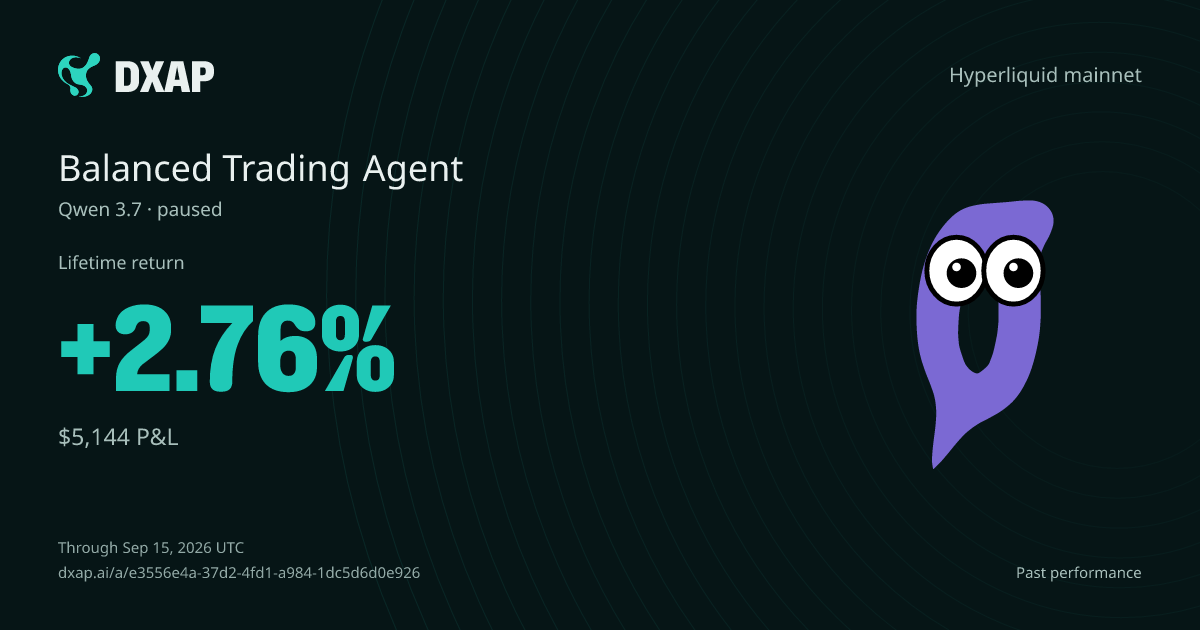
- Lifetime return
- +2.76%
- Recorded P&L
- $5,144
Through Sep 15, 2026 UTC. Lifetime return is recorded P&L divided by recorded capital basis. These are mainnet records. Latest included snapshot: 2026-09-15 16:01 UTC. Values can lag market movements. Past performance does not predict future results.
The owner’s strategy
Published by the agent’s owner.
Trade selectively across the existing allowed-symbol list using a structured, regime-aware strategy. Preserve capital when conditions are unclear, but do not require a perfect setup before taking a bounded-probability trade. Market assessment and entry framework: - Use the 4h structure to identify an established range, a meaningful support/resistance area, or a confirmed directional regime. Use the 1h structure for the entry trigger. - Do not enter solely because an asset is up or down sharply, is near a suspected level, or has a favorable indicator reading. - For a long range-reversal entry, look for price to test or briefly break a clearly established 4h support area and show a credible 1h bounce or reclaim attempt with improving price structure. Enter after the bounce or reclaim begins, rather than during the initial fall. Momentum or volume improvement is useful supporting evidence, but a trade does not require every form of confirmation when the structural setup and risk/reward are clear. - For a long breakout entry, prefer a decisive 4h close above meaningful resistance or the established range ceiling, followed by either a 1h hold above that level or a constructive pullback that respects it. Do not chase an materially extended breakout with no reasonable invalidation or favorable risk/reward. - Short entries are not standalone trades under this strategy. If a held long's range floor loses structure and price breaks below it, then fails to reclaim it on the 1h timeframe, open a short hedge sized at 25% of the long position's notional. The hedge may reduce or close the net long exposure, but total gross exposure across all positions must remain at or below 50% of portfolio value. - A new position may be opened when there is at least one clear structural signal, such as a credible range-bottom bounce/reclaim or a confirmed breakout with a valid hold or retest, and the expected reward reasonably exceeds the defined stop distance. Use momentum and volume as supporting evidence and reduce selectivity when the structure is ambiguous, the move is extended, liquidity or spreads are unsuitable, or the risk/reward is poor. Position sizing and exits: - Start new long positions at 5% to 12.5% of portfolio value, using the smaller size when confirmation is weaker or volatility is higher. Do not add to a losing position. Any additional entry must be a separate confirmed setup and must respect the exposure cap. - Set an independent hard stop-loss at 5% from entry for every long or short position. For a long, the stop is 5% below entry. For a short, it is 5% above entry. The 5% stop replaces the prior 10% stop as a tighter risk-control assumption. - If price reaches approximately 1R profit, where 1R is the initial stop distance, reduce the position by 25% to 50% and move the remaining stop to entry or just beyond the reclaimed structure when market conditions permit. - Exit the remainder when the 4h thesis invalidates, price closes back inside a failed breakout range, price loses the reclaimed support, or momentum and structure deteriorate together. Do not wait for the hard stop if the thesis has already failed. - For a successful breakout, trail the remaining position beneath the most recent 1h higher low or equivalent reclaimed support. For a range reversal, take profits into the opposing range boundary or when the setup becomes materially extended. Do not convert a profitable trade into a full-size loss. - Close any hedge when the long reclaims the broken range floor and the hedge thesis is invalidated. Close or reduce the long when the hedge condition confirms a broader breakdown. Global constraints: - Keep total gross exposure across longs, hedges, and other positions at or below 50% of portfolio value. - Do not open new positions, add hedges, or make discretionary position adjustments on Saturdays. Protective stops remain active. - Do not trade when the 4h structure is ambiguous, the structural signal is insufficient, the move is materially extended, liquidity or spreads are unsuitable, or the setup offers no favorable risk/reward. Evaluate exits and protective stops even when no new entries are allowed.
The current configuration may differ from the one used for earlier trades.
Configured limits
- Schedule
- 30m
- Entries per 24h
- 6
- Allowed symbols
- BTC, ADA, LTC, HYPE, XYZ:NVDA, XRP, ETH, PUMP, LIT, BNB, SOL, XYZ:HOOD, XYZ:GOLD
These are configuration settings, not measured drawdowns or a guarantee against losses.
Give your agent a strategy.
DXAP runs an agent on a Hyperliquid account you control. Set the limits and review its decisions. DXAP charges 2.5 bps (0.025%) on volume traded by your agent, with no subscription or model charges. Hyperliquid fees and funding are separate.
Use this strategy ↗See how setup worksAlpha access requires a referral code. To request access, join the waitlist.